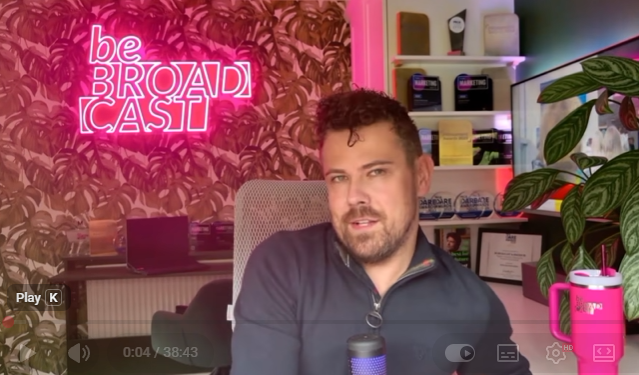
When Accidentally Brilliant started, the idea was pretty simple.
Josh Tracey-Wheeler is nosey.
He wanted to know how interesting people got into what they do, particularly when there was an unusual route, a deep specialism or a career that had not gone quite according to plan.
Twenty episodes later, something else has happened.
The conversations have become a bit of therapy, a guide and, at times, almost a cheat sheet for the parts of a career in PR and communications that nobody really prepares you for.
The things that go wrong. The skills you suddenly need when you become more senior. The decisions founders only discover once they are responsible for the whole business. And the moments when somebody else’s experience lets you hear the lesson before having to learn it the hard way yourself.
So for episode 20, Josh went back through the conversations and pulled out the things that stayed with him. Not necessarily the biggest moments. The ones he kept thinking about afterwards.
Remember What Does Not Change
The communications industry is very good at getting excited about whatever has just arrived.
Andy Nairn offered a useful counterweight to that. Drawing on advice from Bill Bernbach, his point was that people spend a lot of time concentrating on change and not enough understanding the things in human behaviour that stay remarkably consistent.
Love, hope, aspiration and fear do not disappear every time a new platform arrives.
His rule: “Don’t get seduced by the latest new toy.”
Rob Waugh comes at a similar question from the other direction. As AI gets better at producing competent words, images and content, he thinks the odd, individual and recognisably human parts of us become more valuable.
His advice was considerably less corporate:
“Be weird, be eccentric, follow your nose, just be yourself.”
Technology keeps changing. Understanding people, and having some actual personality, still matters.
You Do Not Build A Career On Your Own
Laura Burch gave us one of the stories that stayed with us most.
An autistic colleague, Sophie, was presenting to a client while using the fidget toys that helped her work comfortably. Afterwards, the client told Laura she had an autistic daughter and had worried about what her working life might look like one day.
Seeing Sophie thriving changed something for her.
As Laura put it: “That visibility is so powerful.”
Barbara Phillips made a related point about entering PR when very few people around her shared her background. Her advice now is simple: don’t do it alone. Find people who have been there before, ask the questions and build a network before you desperately need one.
Sara Thornhurst talked about what good support at work looks like. When somebody asks for help, uncertainty can be one of the biggest sources of anxiety. Who will know? What happens next? Will I be treated differently?
Her advice is to make the process clear and give people control over what happens to their information.
Sheeraz Gulsher from People Like Us talked about winning hearts and minds, combining the human argument for change with evidence about what it means for organisations.
And Advita Patel deliberately listens to people she disagrees with. For communicators, surrounding yourself only with people who see the world as you do makes understanding an audience considerably harder.
Different lessons, but a pretty consistent thread: careers get easier when you understand people beyond your own experience.
The Job Changes As You Get More Senior
Stephen Waddington talked about one of the biggest jumps in a communications career.
You can become an excellent practitioner, keep getting promoted and then suddenly discover the job has changed.
Now you need to manage people. Understand finance. Data. Planning. Strategy. Measurement. Risk.
Being good at PR does not automatically prepare you for any of that.
Darryl Sparey had little patience for another familiar line:
“I’m not a numbers person.”
Neither was he.
He taught himself Excel, forecasting, Salesforce and the commercial skills he needed. Eventually some of those became among the most valuable skills in his career.
Daniel Cohen then takes that one step further.
Faced with huge amounts of management information, he eventually asked the most senior finance person a very simple question:
“Which is the one number that’s most important to you?”
Learning more is useful. Knowing what actually matters is better.
PR Has To Mean Something
James Crawford thinks evaluation should be management information.
Not something bolted onto the end of a campaign so everybody can look at the report and say, “isn’t that great?”
Measurement should help people make decisions while the work is happening, show what communications contributes and help protect budgets.
Nigel Sarbutts makes the same argument about how PR people describe their work.
We tend to list activity: campaigns, media relations, content, events, strategy.
His advice is to talk about impact instead. What changed because the work happened?
Jennifer Delgado and Ashley Rudd bring it right back to the beginning.
Clients sometimes arrive asking for “a bit of press”.
The useful questions are why, what are you trying to achieve, and what would success actually look like?
Coverage itself is rarely the destination.
Knowing where you are trying to get to makes it much easier to work backwards and decide what PR needs to do.
Running The Business Changes The Rules
Jo Carr remembered one of the strangest things about leaving a larger organisation and running her own agency.
She was used to checking decisions.
Then her co-founder James pointed out:
“Jo, we can agree something, and then we can just do it.”
At some point, there is nobody else waiting to approve the decision.
Caroline Eardley learned a different agency lesson.
A huge Tesco account helped transform her business. It brought growth, staff, an office and momentum.
It also became far too important.
Her lesson afterwards was clear:
“If one client goes, it can’t be a house of cards.”
The interesting thing is that the risk originally looked exactly like success.
And Nina Webb thinks founders should be thinking about what happens without them much earlier than most do.
Her advice is to have a succession plan from the beginning.
Founders spend years making a business depend on them. Eventually, building something that can thrive without them becomes part of the job too.
People Are Still People
Kate Hartley made a point about crisis that applies well beyond crisis communications.
We think a lot about what happens during one. Less about what happens afterwards.
Crisis brings adrenaline, urgency and focus. When it ends, people do not instantly return to normal.
“You have to recover afterwards.”
Her teams deliberately build recovery into crisis simulations.
And Yvonne Eskenzi gave us perhaps the simplest advice across all 20 episodes.
Do not let titles, seniority or status intimidate you.
However impressive somebody looks on paper, they are still another person sitting opposite you.
Or, as Yvonne puts it:
“People are all people.”
The Things Most Of Us Learn On The Way
Looking back across 20 episodes, relatively few of the lessons that stayed with us were about the mechanics of PR.
They were about understanding people, learning skills that do not come naturally, asking better questions, finding support, becoming comfortable with responsibility, making businesses more resilient and looking after yourself when the work gets difficult.
Most careers do not come with instructions for those bits.
That is probably why hearing people speak honestly about how they dealt with them is so useful.
You still get to make your own mistakes.
You might just avoid a few of theirs.
Episode 20 of Accidentally Brilliant, The PR Career Advice Nobody Teaches You, is available now.